
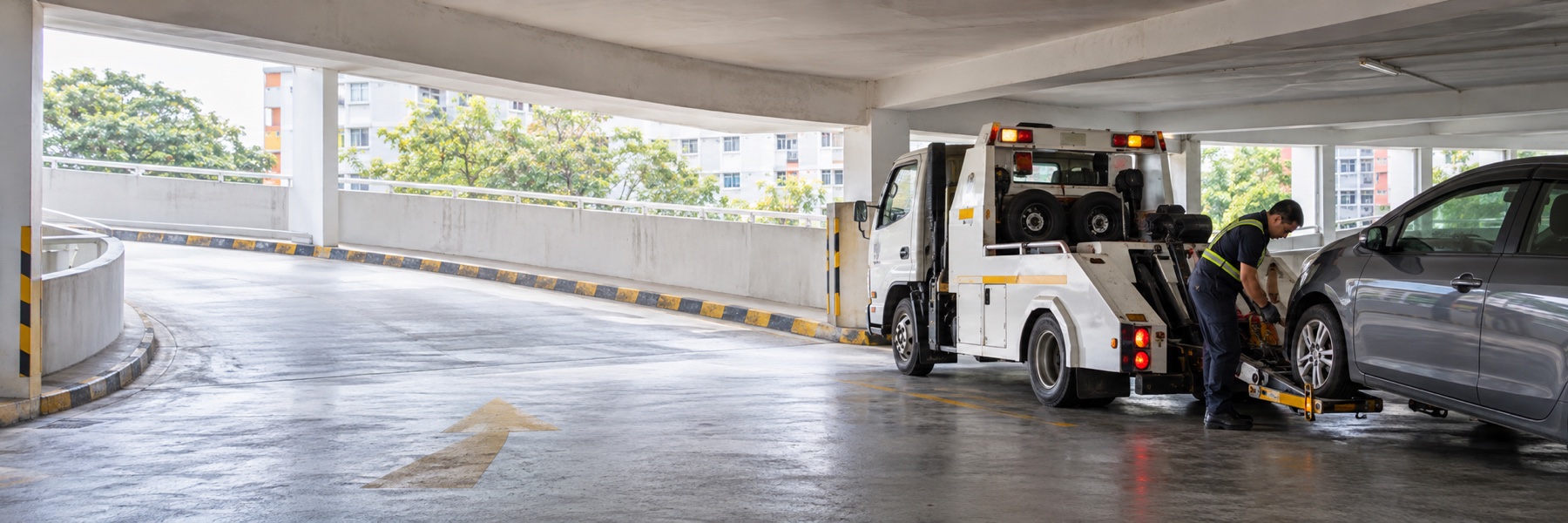
Towing from basement and multi-storey carparks
- 01Carpark accessShare the height limit, entrance route, level and bay.
- 02Vehicle conditionDescribe whether the car rolls, steers or has damage.
- 03Recovery planDiscuss suitable equipment and a receiving destination.
CARPARK TOWING AND RECOVERY
A car that will not start in a basement or multi-storey carpark presents a different problem from one stopped on an open road. The entrance may have a height bar, the ramps may be steep and the vehicle may be parked in a narrow bay.
Express Towing’s roadside assistance page says it can assist in indoor and underground carparks with a special low tow truck. The exact approach still depends on the site and the condition of the vehicle.
Good information before dispatch helps the team assess whether its equipment can reach and move the vehicle. This page covers the checks that matter: clearance, route, steering and wheel condition, permission to access the carpark and a suitable destination after exit.
Why carpark recovery needs planning
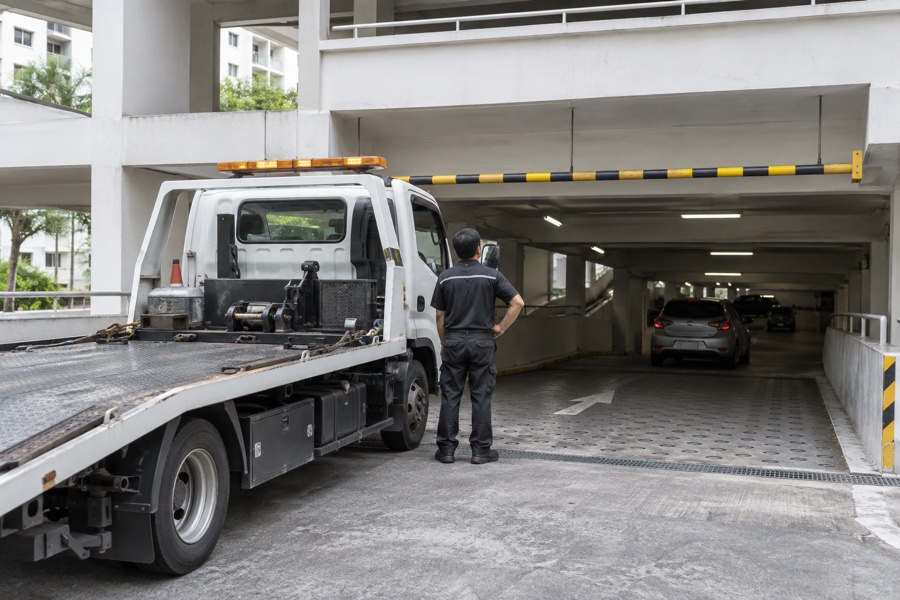
A standard recovery truck may not fit through a basement entrance or around an internal corner. Posted height limits are only one part of the assessment. Beams, pipes, sprinkler systems, gantries, gradients and turning space can all reduce the usable route.
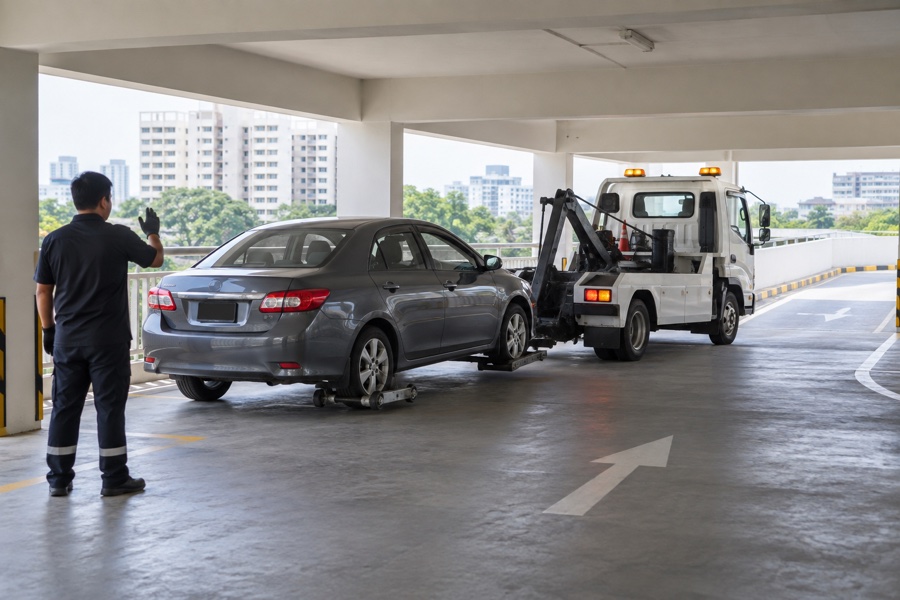
Even if the truck can enter, it must be able to reach the vehicle, position safely and leave without blocking other users or striking the building.
When you enquire, give the carpark name and full address, level and bay number, posted height clearance and the entrance that vehicles use. Describe tight corners, steep ramps, low sections and any obstruction near the car. A photograph of the height bar, entrance, route and parked vehicle can be more useful than an estimated clearance.
The team can then decide whether a low-clearance truck or another method is appropriate.
Tell us whether the vehicle can move
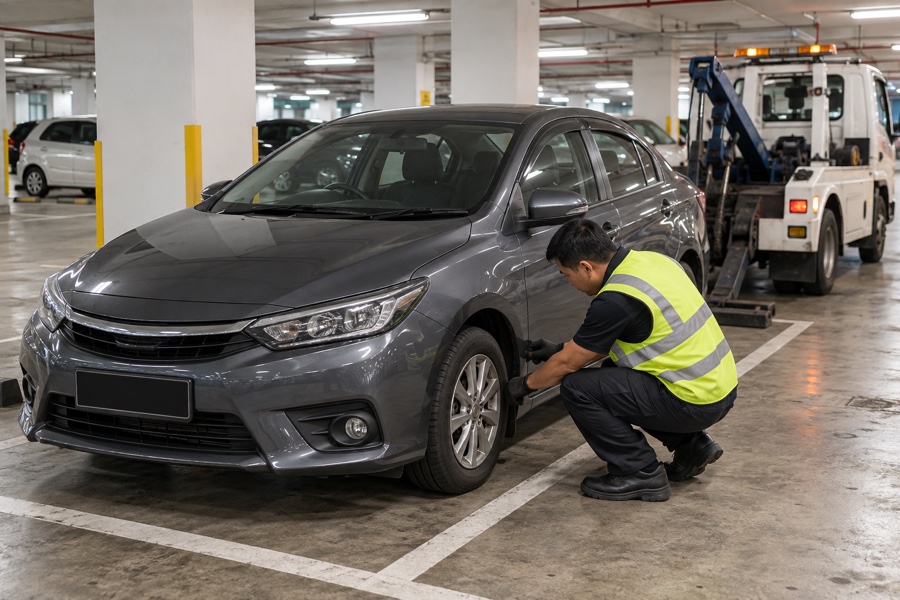
A flat battery may leave the car stationary even though it can otherwise roll and steer. A damaged wheel, seized brake, transmission fault or accident damage may make it much harder to move. Explain whether the doors open, keys are available, steering unlocks, the parking brake releases and the wheels can turn.
For an electric or hybrid vehicle, identify the model and follow its manufacturer’s instructions about moving it when disabled.
Some problems may be resolved without a tow. Express Towing’s battery service includes roadside jump-start and replacement, while its tyre service covers assessment and repair or spare-tyre fitting where appropriate. If the vehicle cannot be made safe to drive, towing can be considered.
Do not try to force a car with locked wheels or damaged steering up a ramp to simplify collection.
Arrange access with the carpark
HDB, condominium, office and shopping-centre carparks can have different access rules. The owner or driver may need to tell security or management that a recovery vehicle is coming. Ask about entry permissions, loading areas, height-restricted gates and whether there is a route that avoids a tight ramp.
If the car has stopped behind a barrier or in a restricted lot, provide the relevant access contact before the truck arrives.
Confirm where the vehicle can be transferred or loaded if the recovery truck cannot enter the basement. That decision depends on whether the car can be moved safely, the tools available and the building’s traffic arrangements. It should be planned with the operator and site staff rather than improvised in a busy carpark.
A failed first attempt can waste time and inconvenience other drivers.
Information to gather before calling
Record the carpark address, entrance, parking level, bay number and stated clearance. Share the car’s make, model and condition, including any visible damage or low ground clearance. Note whether the keys are with the vehicle, whether it can roll and whether another car blocks access.
If a security office controls the entrance, give its operating hours and contact route. This allows the recovery team to assess the route as well as the vehicle.
Choose a destination that can receive the car
Before collection, decide whether the car should go to a workshop, service centre, home or another agreed destination. Check that the destination is open or has an after-hours handover arrangement.
If the car was damaged in an accident, consult your insurer about the permitted towing operator and reporting centre before arranging a separate tow; the General Insurance Association’s accident guidance explains the insurer and authorised-workshop steps. An insurance requirement does not disappear because the car is parked indoors.
Expect a site-specific assessment
Carpark layouts vary greatly. A claim that a company handles basement towing should not be read as a guarantee that every height-restricted facility or vehicle condition is accessible. The operator needs the real clearance, turning and loading information before confirming what is possible. Ask for the intended method and quotation after those details are reviewed.
If the vehicle is already in an open roadside location, the general car towing page is a better overview. Carpark recovery deserves its own discussion because site access can be as important as the mechanical fault.
Make the first recovery visit count
Sending a truck without the carpark’s height limit, entrance route or vehicle condition can lead to the wrong equipment arriving. A short set of clear details and photographs makes the assessment more useful.
Tell Express Towing whether the car needs roadside diagnosis, can be rolled to a loading point or requires full recovery from its bay. The team can then discuss the available option for that particular site.
Keep safety and permission in view. Do not block ramps, dismantle barriers or attempt to pull the car through a tight route without the carpark operator’s knowledge. Once the method and destination are agreed, keep the keys and access contact available for the handover.
Contact us with the carpark details to find out whether a suitable recovery can be arranged.
If the posted clearance is close to the height of a proposed truck, let the operator make the assessment; do not estimate that it will fit. Clearance can vary along a route because of beams, signs and sloping ramps.
The vehicle itself may also be lower than usual if a tyre has failed or suspension is damaged. Both the truck’s route and the car’s movement need to be considered before recovery begins.
For a condominium or managed commercial building, an agreed time may help security control access and keep the exit route clear. Ask whether the destination has similar height or access restrictions, especially if the car is going to another underground facility.
Sharing both ends of the journey in advance makes the arrangement more complete than focusing only on getting out of the original parking bay.
Frequently Asked Questions
What information is needed for a carpark recovery? | Give us the carpark address, entrance, level, bay number, posted height clearance and a description of the ramps and turning space. Photos of the route are useful. |
Can a tow truck enter every basement carpark? | No single method suits every carpark. Clearances, corners, slopes and the vehicle’s condition need to be assessed before access or recovery can be confirmed. |
What if the car cannot roll or steer? | Tell us whether the keys are available and which wheels or controls are affected. That information helps us consider how the car might be moved to a suitable loading point. |
Do we need to speak with carpark management? | If security or management controls access, provide their contact route and any operating hours. Permission and a clear working route may be needed before recovery begins. |
Where should the vehicle go after leaving the carpark? | Agree on a workshop, service centre or other receiving point before collection. If the car was in an accident, check the destination with your insurer first. |